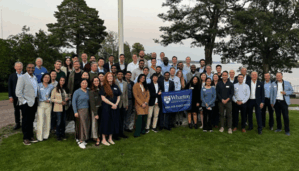
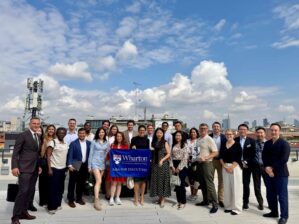
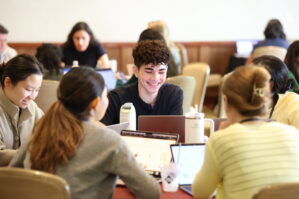
Image: Students prep for mock interviews in the final session of the Career Readiness @ Wharton program. (Image Credit: Weining Ding, W'27)
Career Readiness @ Wharton prepares first-year students to search for internships and jobs.
Contrary to stereotypes, it’s uncommon to find first-year undergraduates walking through campus wearing suits. On Fridays, it’s more likely they’re sitting on blankets in the Quad or chatting over a latte outside of Huntsman Hall’s coffee shop. But, this past February, 90 first-years headed to the Academic Research Building in their nicest professional attire.
That Friday marked the final session ofCareer Readiness @ Wharton, an Undergraduate Division program developed with the Wharton Dean’s Undergraduate Advisory Board (WAB) to help first-years understand the breadth of industry exploration and prepare for the internship-search process.
The four-week program included presentations on common and niche careers, resume and cover letter workshops, and training in soft skills for interviews and outreach. The last session featured mock interviews conducted by MBAs and alumni, as well as a networking reception.
Career Readiness was piloted in 2024 with 50 first-years. It officially launched in 2025 with 90 participants, with the goal to continue expanding each February.
WAB members Lizzie Guan, W’25, and Caroline Keswin, W’25, helped create the program based on their past internship and job-search experiences.
“The biggest thing that we’re trying to articulate is that no recruiting process is the same,” Caroline said. “Everyone goes through their own struggles, obstacles, and successes.”
The program was strengthened by including third- and fourth-years who had just finished their internship- and job-search processes.
Each first-year was paired with a learning assistant (LA), upper-level students with internship and employment experience across a variety of industries. Many LAs said they were offering what they would have liked for themselves.
“I [was] able to talk to people who were once in my shoes, who have a genuine story that compares to mine and taught me steps they wish they had taken,” said participant Addison Saad, W’28.
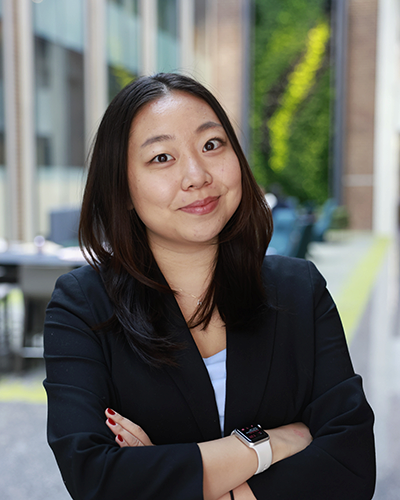
Haerin So, W’25 (Image Credit: Weining Ding, W’27)
Learning assistant Haerin So, W’25, used her experiences across investment banking, private equity, research, and consulting to help first-years understand what working in different industries actually entails.
“Time has gone by so fast. I haven’t really taken the time to think about what I wish I could have told my first-year self, but I’ve grown to be a little more candid,” she said.
At Wharton, everybody understands the concept of “paying it forward” and is willing to help undergraduates seeking advice. Iian Chen, W’28, said that was a major reason he chose Penn.
“I’ve talked to industry professionals who stress the importance of mentorship,” the Atlanta native said. “Mentorship is just something that’s part of Penn culture.”
The LAs fulfilled a unique need for students: candor and honesty about their failures, according to Haerin. Addison, a first-year at the time, agreed.
“I see these people as a casual resource,” she said. “I feel like I can ask questions that I’m scared to ask other people at Penn.”
The Houston native mentioned that the LAs’ frankness about failure helped her see them not only as resources but as friends.
Haerin saw that as a highlight of her relationship with the first-years: “You only really get this vulnerability when you’re assigned peer-to-peer mentors.”
“I [was] able to talk to people who were once in my shoes, who have a genuine story that compares to mine and taught me steps they wish they had taken.”
Throughout that Friday in February, first-years walked in and out of rooms in the Undergraduate Division. They left excited, whispering among themselves: How’d it go? Was he scary? It can be hard to remember these are only mock interviews, but the program aims for authenticity.
The interviewers — MBA students and recent Wharton alumni — are eager to assist. Jordan King, W’21, a consultant at Deloitte in Philadelphia, attributes his continued involvement with Wharton to his own mentorship at Penn through programs like the Successful Transition and Empowerment Program (STEP). He noted that interviewees were “very polished and well prepared.”
“A lot of the applicants I interviewed today showed great vulnerability and maturity,” Jordan recalled. “That’s something that even somebody like myself, who might be more experienced, needs to remember to be empowered in terms of being more open and transparent.”
Jordan looked both nostalgic and hopeful as he continued, reminded of how much can be accomplished at a young age. “It’s a reaffirmation, a reminder for someone as myself, who’s not very far in my own career, just to remember how much and how many ways that I’ve impacted people.”
A helpful aspect for participant Iian was the first session, which required reflecting on personal values and exploring which careers align with those.
That reflective quality continued as he spoke with alumni on the final day: “They stress where you start — it’s definitely not a linear path to where you end up wanting to be,” he said. “It’s something to consider when choosing what career to go into initially.”
The recruiting cycle is often marked by confusion — conflicting deadlines and timelines among companies, as well as a paralyzing number of career opportunities. The Career Readiness @ Wharton program was started to help students feel more prepared. However, it has also helped students better understand the job-search process by focusing on opportunities for authenticity and aspiration, and to think of networks as real human connections.
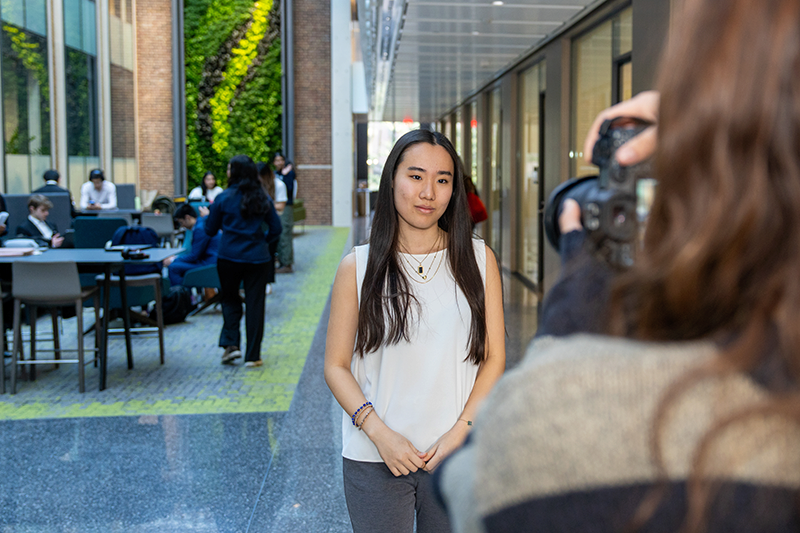
A student gets a headshot taken as part of the Career Readiness @ Wharton program. (Image Credit: Jackson Eli Ford, W’27)
Open to first-year Wharton students, Career Readiness @ Wharton combines instruction from career-education professionals with mentorship from upper-level Wharton students. The program aims to help students explore industries and gain confidence and skills essential to a successful job search.
The monthlong program offers four half-day sessions during February, culminating in first-years’ applying what they have learned through mock interviews and a networking reception with alumni.
Sessions
Explore — Students delve into various industries, expanding their understanding of career opportunities and leveraging resources like LinkedIn and alumni networks to do so.
Engage — Students gain essential skills from resume building to email etiquette to interview preparation.
Launch — Students are empowered to leverage their preparedness and practice optimal networking techniques and organizational methods crucial for successful career advancement.
Apply— Students apply their newly acquired skills in mock interviews and at a networking event with Penn alumni.
Lizzie Guan, W’25, helps a first-year student prep for a mock interview. (Image Credit: Weining Ding, W’27)
Wharton Stories
Prof. Kent Smetters Challenges EMBA Students to Think Like Economists
Image: Prof. Kent Smetters in conversation with former Federal Reserve Chairman Alan Greenspan at Perry World House in 2019. (Image Credit: Wharton Magazine)
“We teach you how to think critically, how to use data effectively, and how to adapt. That way, when your industry shifts — and it will — you’ll have the knowledge and skills required to innovate and lead the way forward,” says Prof. Kent Smetters.
At Wharton, Prof. Kent Smetters, the Boettner Chair Professor, is known among EMBA students for teaching one of the program’s most challenging core courses: Managerial Economics. But as one former student says, “It’s hard in the right ways.”
“My goal isn’t to make the course hard just to be hard,” explains Smetters. “It’s about pushing students to think differently.”
Prof. Kent Smetters (Image Credit: The Wharton School)
Instead of memorizing formulas, students learn to take a real-world narrative with numbers and data and translate it into an economic model that provides insight. The course teaches them to think through tradeoffs, understand optimization, and apply theory in practical situations.
“That kind of critical thinking is what leaders need in order to make smarter decisions,” he says.
Smetters’ demanding approach reflects his broader philosophy: research and teaching should prepare people not only to understand the world as it is today but also to anticipate how it will change. That perspective comes from a career that bridges academia, public policy, and applied economics.
Engineering a New Kind of Policy Analysis
Smetters grew up in rural Ohio before earning his PhD in economics from Harvard. Rather than immediately pursuing an academic career, he took an unusual path for a new PhD: he went to Washington, DC to work at the Congressional Budget Office. Later, he served as Deputy Assistant Secretary of Economic Policy at the U.S. Treasury during the George W. Bush administration, a period that included the aftermath of 9/11, the Enron collapse, and the drafting of Sarbanes-Oxley.
Those experiences gave him a deep appreciation for how policy is made and what changes are needed. “Agencies are sometimes criticized for being biased, but that’s not the case. The problem is that they are very far behind when it comes to modeling.”
That insight ultimately led to the Penn Wharton Budget Model (PWBM), which Smetters now directs. PWBM is a software-engineering-driven shop that builds sophisticated, scalable models of how policies interact across the economy. Policymakers on both sides of the aisle turn to PWBM for analysis that is rigorous, transparent, and trusted.
“What distinguishes us,” Smetters explains, “is that we’re not chasing headlines. We do deeper analysis, and our models are built so others can understand and build on them. It’s modern economics combined with engineering. That’s why we’re trusted across the political spectrum.”
PWBM also offers a free certificate program, giving participants (including some Wharton EMBA graduates) a deeper understanding of policy modeling and fiscal analysis.
Research With Purpose
Smetters’ academic work continues to push boundaries in applied theory, fiscal policy, and finance. His projects range from modeling the long-term effects of Social Security reforms, to analyzing the effectiveness of minimum wage as a redistribution tool, to studying how tax policies affect venture-capital-backed entrepreneurs.
“This work is very math intensive,” he says, “but the purpose is always to make research useful at scale. It’s about solving problems that once seemed too big to model.”
Smetters’ applied approach has earned recognition, including theTIAA Paul A. Samuelson Award for his research on annuitization.
Beyond the Classroom
While Managerial Economics is the main way EMBA students interact with Smetters, he also supervises independent studies.
One standout independent study project involved a student’s exploration of whether wine could become a financial asset class. Using economic and financial modeling, the student discovered how wine auction dynamics correlated with markets and even identified underpriced vintages.
Other projects have ranged from startup concepts to industry-specific analyses, all grounded in applying classroom concepts to real-world questions.
“My role is to help students take the tools they’ve learned and apply them in creative ways,” he explains. “The best projects start with a question that matters to the student and then build an economic and data-driven approach to finding answers.”
A Message to Prospective Students
For prospective students, Smetters offers a candid perspective on Wharton’s EMBA program: “This is the hardest MBA program in the hardest format. You and your household are making a serious investment, and you need to come in with that mindset.”
But the payoff, he emphasizes, is worth it. “Graduates are incredibly satisfied because they know they’ve been pushed hard to grow,” he says. “We don’t just teach you the tools of your trade today, because those will change. We teach you how to think critically, how to use data effectively, and how to adapt. That way, when your industry shifts — and it will — you’ll have the knowledge and skills required to innovate and lead the way forward.”
Current Position: Boettner Chair Professor and Professor of Insurance and Risk Management (Wharton); Director of the Penn Wharton Budget Model; Faculty in Applied Mathematics and Computational Science (Penn); Faculty Research Fellow, National Bureau of Economic Research
Wharton Stories
Huntsman Program Fourth-Year Florence Onyiuke Named a 2026 Rhodes Scholar
Image: Huntsman Program fourth-year undergraduate Florence Onyiuke is a 2026 Rhodes Scholar. (Image Credit: Penn Today, Courtesy of Florence Oyniuke)
Onyiuke has been awarded a 2026 Rhodes Scholarship, which funds tuition and a living stipend for graduate study at the University of Oxford in England. She is among 32 American Rhodes Scholars and an expected 100 worldwide.
The Rhodes, established in 1902, is highly competitive and one of the most prestigious scholarships in the world. The scholarship funds tuition and a living stipend for two or three years of graduate study at Oxford, and may allow funding for four years in some instances. At Oxford, Onyiuke plans to pursue a master’s degree in economic development with a focus on West Africa.
Huntsman Program fourth-year undergraduate Florence Onyiuke is a 2026 Rhodes Scholar. (Image Credit: Penn Today, Courtesy of Florence Oyniuke)
Wharton Stories
Venture Lab Honors Entrepreneur and Penn Alumna Tory Burch
Image: Attendees join award recipient Tory Burch, C'88 for the 2025 Penn Wharton Entrepreneurship Alumni Achievement Award. (Image Credit: Noa Griffel)
Penn’s Venture Lab hosted a memorable evening at the Wharton School’s San Francisco campus to honor Tory Burch, C’88 as the recipient of the 2025 Penn Wharton Entrepreneurship Alumni Achievement Award. Burch is the celebrated fashion CEO and philanthropist behind Tory Burch LLC and the Tory Burch Foundation.
The event brought together Penn and Wharton alumni and friends for a celebration of entrepreneurial leadership and community impact.
Wharton’s Global Business Week: Expanding Horizons, Building Connections
Image: Wharton EMBA students in Milan for Global Business Week. (Image Credit: Meg Chiodo)
“[This class] is a prime example of why I chose Wharton: learning, applying, and connecting on a global scale,” says James Brown III, WG’26.
Since its earliest days, Wharton’s MBA Program for Executives (EMBA) has made international learning a cornerstone of the curriculum with its requiredGlobal Business Week (GBW).
Today, GBWs span multiple destinations each year, allowing students from all three cohorts (Philadelphia, San Francisco, and Global) to choose topics and regions that align with their professional goals and personal interests. What hasn’t changed, says GBW Program Director Cathy Molony, is the guiding principle: each location explores issues at the leading edge of global business.
“GBW is about more than academics. It’s about learning across perspectives, connecting with students from other cohorts, and gaining access to opportunities you couldn’t create on your own,” explains Cathy. “It’s a priceless experience that builds both knowledge and lifelong connections.”
Below, six EMBA students reflect on their recent GBWs in Spain, London, New York, Sweden, Italy, and Argentina — and how these experiences expanded their learning and their networks.
Competitive Advantage in the Leisure Industries, Spain James Brown III, WG’26, San Francisco Cohort
For James Brown III, Spain was the ideal destination to explore the intersection of business and leisure. “I wanted to go beyond tourism to really understand the industries that drive local economies like sports, tourism, food, and wine,” he says. “The insights were directly relevant to my work in entertainment and the economic impact of my projects across the U.S.”
Caption: James Brown with classmates in Madrid. (Image Credit: Anastasia Gracheva)
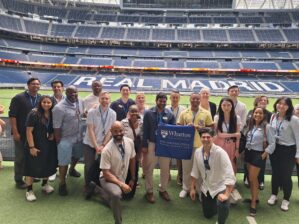
The week began in Barcelona, where students met with city officials and tourism leaders. Sessions explored the effect that large conventions, cruise ships, sporting events, and wineries have on the local economy. They also visited publicly owned FC Barcelona, where they learned about the rivalry with privately owned Real Madrid, as well as the teams’ differing business models.
In Madrid, discussions extended to sports and entertainment entrepreneurship. Students met a former soccer player who now owns Marbella Football Club along with several subsidiary companies, including a talent agency and predictive analytics tech company. Another session explored the strategy of acquiring smaller talent agencies to consolidate resources.
Outside of academics, the week was rich with cultural experiences and bonding. Wine tastings, stadium tours, dinners, and informal discussions helped students connect across cohorts. “The week gave us the chance to mingle, expand networks, and even dream about potential future collaborations, maybe buying a football club together,” he laughs.
For James, the value of the week was immediate and practical. “Having access to these organizations and leaders showed the power of the Wharton brand,” he notes. “The learning was immersive, applicable, and something I can take back to grow my company. It’s a prime example of why I chose Wharton: learning, applying, and connecting on a global scale.”
Exploring AI in Emerging Technologies in London Katrina Siegfried, WG’26, Philadelphia Cohort
Katrina Siegfried chose London for her GBW because of the subject matter. “I work in a highly regulated industry, and there’s hype around AI, but not everyone knows how to generate real value from it,” she says. “I wanted to see how companies in another highly regulated sector are using AI, and how regulators in the UK are approaching it.”
Caption: Katrina Siegried with classmates in London. (Image Credit: Diane Sharp)
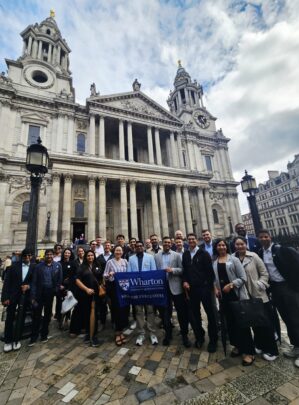
The week included visits to NatWest andMcKinsey, as well as conversations with regulators shaping AI legislation. The NatWest visit was particularly powerful. She explains, “This was a bank responsible for bringing down the UK financial system in 2008. Seeing how they’ve rebuilt and now use AI successfully was incredible.”
Another highlight was the visit to McKinsey, where the presentation was so practical that it inspired Katrina to write her own AI program when she returned to the hotel that evening. “My favorite part of Wharton’s EMBA program is learning something and immediately applying it, and this week was that on steroids.”
Beyond academics, she says the opportunities to get to know her classmates were “invaluable.” Dinners, high tea, and karaoke gave the group time to connect. A Tube strike gave them even more time together, walking and riding buses together around the city.
For Katrina, she says the week encapsulated the best of Wharton’s EMBA experience: “Cutting-edge business insights, practical knowledge, and lasting connections with classmates from around the world who share the same drive to learn.”
Private Equity on Wall Street Jeong Min (JM) Yun, WG’26, Global Cohort
Caption: JM Yun with classmates in NYC. (Image Credit: Takeshi Nagase)
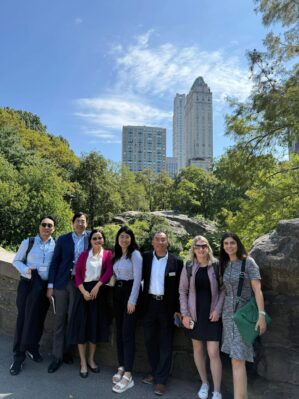
As a finance lawyer originally from Seoul and working in Singapore, JM Yun was drawn to New York for its focus on private equity (PE). “There were many interesting locations, but I wanted to explore PE withProf. Jules van Binsbergen” (the Nippon Life Professor in Finance and Anthony L. Davis Director of the Joseph H. Lauder Institute for Management and International Studies).
Students visited six PE firms ranging from mega funds to medium-sized players, while Prof. van Binsbergen layered in lectures on the history and future of private equity. Walking tours of Wall Street added historical perspective, including a visit to Ground Zero the day before 9/11’s anniversary.
As a member of the Global cohort, JM valued the chance to connect in person with peers from all three cohorts. “We got to know each other at dinners, Broadway shows, and alumni networking at thePenn Club. These conversations deepened connections and gave me perspectives from students in tech, AI, and venture capital.”
Academically, the week reframed JM’s understanding of PE. “Before, I thought of PE as deep financial engineering,” he says. “But what stood out was the operational aspect, creating value through industry expertise and operational excellence. As a lawyer, I’ll apply this lens in Asia-Pacific where PE is growing rapidly.”
Customer Centricity in Sweden Margot Gates-George, WG’26, San Francisco Cohort For Margot Gates-George, choosing Sweden was about the opportunity to learn directly fromProf. Peter Fader, the Frances and Pei-Yuan Chia Professor. “I had heard from an alumnus that you can’t go to Wharton and not take one of his marketing classes,” she explains. “When I saw he offered a GBW in Sweden on customer centricity, I knew I had to go.”
Caption: Margot Gates-George with classmates and Wharton alumni in Stockholm. (Image Credit: Mats Karlsson, WG ‘24)
The week began with an introduction to Swedish culture and workplace values followed by full days of visits with firms like Funnel IQ, IKEA, Paradox Games, and Scandinavian Airlines.
As a former Navy pilot, Margot found the visit to Scandinavian Airlines especially meaningful. “I’d flown with them before, but hearing directly from the CEO about how they invest in both operations and customer experience gave me a completely new perspective,” she says.
For Margot, the biggest takeaway of the visits was the importance of understanding who drives a company’s revenue. “If 90% of your revenue comes from 10% of your customers, how do you build strategy around them? That question reshaped how I think about marketing and customer engagement.”
Outside the classroom, the opportunity to forge meaningful connections with peers from different cohorts proved just as valuable. Margot deliberately sought out people she would not have had a chance to connect with otherwise, spending evenings at dinners, museums, and karaoke. She walked away from her GBW experience grateful for having learned from Prof. Fader and for having forged deep, lasting relationships with classmates who truly inspired her. “It felt like we were full-time students for a week. Without the usual distractions of work and commitments of family, we had the time to really focus on each other, build friendships, and share advice. That was as rewarding as the academic experience.”
Sustainability and Luxury in Italy Parashar Saikia, WG’26, Global Cohort
Caption: Parashar Saikia with classmates on the rooftop at Buccellati in Milan. (Image Credit: Meg Chiodo)
For Parashar Saikia, Italy offered a chance to learn about a completely new sector. “Working in oil and gas, I wouldn’t otherwise have the opportunity to see the luxury industry up close,” he explains. “I also wanted to explore sustainability through a completely different lens.”
The week opened with a Boston Consulting Group session framing sustainability in luxury, followed by visits to companies like Ferrari, Ferragamo, Prada, Armani Hotels, and Alessi. Each company showed a different approach to sustainability, whether rooted in culture, governance, environmental stewardship, or preserving craftsmanship.
“I was pleasantly surprised at how seriously these companies walk the talk in the areas they focus on,” says Parashar. “The balance between profitability and sustainability isn’t a simple trade-off. These companies are weighing both strategically.”
He adds that another highlight was the class bonding, which happened during the company visits as well as dinners and opera nights. “This was a great opportunity to connect with people across cohorts in person.”
For Parashar, the biggest value was the unique access Wharton provided to the luxury industry. “At Ferragamo’s headquarters, we sat in a 13th-century palace!” he says. “These are doors that would never open without Wharton.”
Doing Business in Turbulent Environments, Argentina Ovsanna Khachikian, WG’26, Philadelphia Cohort
For Ovsanna Khachikian, choosing Argentina came down to the professor. “I had taken a prior course withProf. Exequiel (Zeke) Hernandez [Max and Bernice Garchik Family Presidential Professor] and knew his GBW course would be just as thoughtfully designed. He presents frameworks that are clear and transferable, helping make sense of complexity across industries and geographies. The focus on navigating volatility through entrepreneurship made it especially relevant in the current era of economic and geopolitical uncertainty,” she says.
Caption: Closing out the week with remarks and reflections at the Palacio Duhau Park Hyatt in Buenos Aires. (Image Credit: Astral Group)
The week started with an academic overview at IAE Business School before moving into visits with leaders across public and private sectors. The group met with a venture capitalist and startup founders as well as a senior leader from Mercado Libre, the leading e-commerce platform across Latin America, founded by Wharton alumnus Marcos Galperin. They also participated in a Q&A session with Minister of Finance Pablo Quirno, another Wharton alumnus, who shared insights into the current administration’s reforms aimed at stabilizing the economy.
One key lesson came from a fintech startup founder, who raised millions at the ideation stage and was able to simultaneously expand into multiple markets. “In the absence of stable markets, we learned that relational governance takes precedence,” Ovsanna explains. “His reputation and credibility allowed him to attract investment even when the broader market-based institutions were unreliable.”
Beyond academics, Ovsanna embraced opportunities to connect with classmates during shared meals and bus rides as well as while touring landmarks, including Teatro Colón and La Recoleta Cemetery. “Especially when abroad, I find shared learning and exploration really accelerates connection and fosters a rare depth of camaraderie among classmates,” she says. Her personal highlight was exploring Argentina’s multicultural identity with a stroll down Armenia Street in Palermo with classmates, appreciating the references to her heritage.
For Ovsanna, the impact of GBW went far beyond the classroom. “This was a masterclass in leading through uncertainty that would be difficult to capture in a textbook or case study. I left Argentina with lasting insights on how the boldest leaders remain focused on priorities even amidst instability and why relationships and resilience matter as much as strategy,” she says.
Current Role: President & Chief Creative Officer, Story House, Inc. (Co-Founder)
Previous Education: Brown University, BA Psychology
Image Credit: Roka Studios
Katrina Siegfried, WG’26 Cohort: Philadelphia
Location: Golden, CO
Current Role: Software Engineering Development Manager, Terumo Blood and Cell Technologies
Previous Education: University of Colorado, BS Mechanical Engineering; University of Colorado, Master’s in Integrative Physiology, Engineering Management, Computer Science
Image Credit: White Room Studio, Singapore
Jeong Min (JM) Yun, WG’26
Cohort: Global
Originally From: South Korea
Location: Singapore
Current Role: Legal Consultant
Previous Education: Korea University, BA Korean Law; Vanderbilt University, JD; University of Michigan, MBA
Image Credit: Danielle Poff
Margot Gates-George, WG’26
Cohort: San Francisco
Location: San Francisco Bay Area
Current Role: Public Affairs Manager, Meta
Previous Education: U.S. Naval Academy, BS Political Science and Government
Image Credit: Lori Harrington
Parashar Saikia, WG’26, Global Cohort Cohort: Global
Originally From: India
Location: Houston, TX
Current Role: Scenario and Prioritization Manager, Shale and Tight, Chevron
Previous Education: Louisiana State University, BS Petroleum Engineering
Image Credit: Michelle Hill
Ovsanna Khachikian, WG’26
Cohort: Philadelphia
Location: New York City
Current Role: Director of Human Resources and Operations, NYC Department of Education
Previous Education: University of California, Berkeley, BA Political Economy; Columbia University, Master’s in Leadership and Policy
Wharton Stories
How This Veteran Is Building Business Acumen With Wharton’s EMBA Program for the Next Stage of Growth
Image: Brad Mears, WG’26, (Center, Rear) ringing the bell with his Figure coworkers. (Image Credit: Nasdaq, Inc.)
“When I joined my company, we were small and growing fast. Now, the opportunities ahead are bigger and more complex than when I started, which makes the timing of Wharton even more relevant,” says Brad Mears, WG’26.
When Brad Mears, WG’26, got out of the U.S. Marine Corps, he thought about getting an MBA, but the timing wasn’t right. He had just begun working in the private sector and decided to get more professional experience before going to business school.
Brad Mears, WG’26, during his service in the U.S. Marine Corps. (Image Credit: Justin Hemeyer)
After eight years, first at PayPal and then the startup Figure, Brad was ready for school. He explains, “I realized that to grow as a leader, I needed a deeper understanding of business fundamentals. I’d developed strong product management skills but — to be truly effective in financial services — I needed the broader business toolkit that Wharton provides.”
A Career Built in Fintech
Brad’s career in tech started at PayPal, where he worked as a program manager. “It was an awesome place to start and get my foot in the door,” he says. But soon, he felt the pull toward a steeper learning curve and the chance to work directly in product management.
That led him to Figure, a fintech company that’s transforming capital markets through blockchain. Over the past six years, Brad has played a role in the company’s remarkable growth from a 100-person startup to a public company listed on Nasdaq (FIGR). “Being part of that journey has been incredible,” he says. “And now the opportunities ahead are bigger and more complex than when I started, which makes the timing of Wharton even more relevant.”
Why Wharton
Brad’s brother, a 2024 graduate of the Philadelphia EMBA cohort, had nothing but positive things to say about the program. Coupled with the GI Bill and Yellow Ribbon Program, which made the degree financially accessible, Brad knew he had found the right fit at Wharton’s San Francisco campus.
“Wharton was a no-brainer,” he says. “The opportunity to earn an Ivy League MBA while continuing to work in San Francisco and stay connected to the tech community was perfect.”
Classroom Insights That Translate to Work
Brad Mears, WG’26 (far left), with classmates on Wharton’s Philadelphia campus (Image Credit: Aansh Jarmarwala)
From the start, the curriculum delivered immediate value. Courses in micro- and macroeconomics gave Brad new ways of understanding the products he manages, which are often in the housing finance space.
“On the micro level, it was eye-opening to learn about pricing and customer decision making,” he notes. “On the macro side, understanding how the Federal Reserve operates and how those decisions ripple through the financial industry was incredibly impactful. It gave me insights I use every day.”
Other courses have been equally relevant. “I loved the class on Disruptive Innovation because it’s so applicable to working in tech in the Bay Area. And Prof. Gad Alon‘s Scaling Operations class has been spot on for where we are as a company.” (Prof. Alon is Wharton’s Jeffrey A. Keswin Professor, as well as Director of the Jerome Fisher Program in Management & Technology.) “When I joined, we were small and growing fast. Now that we’re public, the issues we’re tackling are exactly what we discuss in class.”
The Wharton Community
For Brad, being back in a classroom setting is part of the appeal. “It’s refreshing to step into an environment where the stakes are lower than at work, while engaging in discussions with smart people who bring diverse perspectives,” he says.
His classmates, he adds, are a highlight. “There are so many impressive people in my cohort doing interesting things. We’re all at inflection points in our careers, and I know in five to 10 years I’ll be amazed by where everybody is.”
The San Francisco location has made the experience even more rewarding. “I ride my bike to class, and I’ve built a strong core group of friends here. Those relationships will last long after graduation.”
Balancing Family, Career, and School
Brad began Wharton with a newborn at home, so balancing school with a demanding job and family life has been challenging. The key to finding balance, he says, is clear communication, setting expectations, and prioritization.
“You have to be intentional about your time,” he says. “There will always be more you could do, but you can’t do everything. Be clear on what you want to get out of the program, protect time for family, and decide what’s enough for you. The program attracts high achievers, but you don’t have to say yes to everything.”
Looking Ahead
As Brad reflects on his experience so far, the combination of academic growth, career impact, and community stands out.
“It’s been demanding, but it’s worth it,” he says. “Wharton is giving me the tools, the perspective, and the network to continue growing as a leader — and that will pay dividends for the rest of my career.”
Current Role: Director of Product Management, Figure
Image Credit: Ryan Gish
Previous Education: Georgia Institute of Technology, BS in Finance and Business Administration
Wharton Stories
Lauder Institute’s Immersive Journey Through Oman and UAE
Image: Students visit the headquarters of Emaar Properties in Dubai, a global leader in real estate development. (Image Credit: Mili Lozada-Cerna)
Lauder Institute students embarked on an immersive journey through Oman and the United Arab Emirates (UAE) to examine how migration, innovation, and cultural memory shape urbanism in the Middle East and Gulf region. Guided by Sudev Sheth, a senior lecturer in international studies at the Lauder Institute, the Lauder Intercultural Venture (LIV) explored specifically how cities in Oman and the UAE navigate rapid modernization while preserving aspects of their history and heritage.
“This LIV was designed to help students see beyond skylines and infrastructure,” says Sheth. “It’s about understanding how local communities and migrants from around the world transform spaces and spectacular architecture into meaningful, lived environments where technology, tradition, and aspiration meet.”
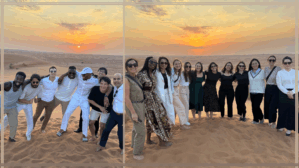
Enjoying the sunset in Al Wasil, Oman. This Lauder Intercultural Venture (LIV) was attended by 18 Lauder Institute students. (Image Credit: Mili Lozada-Cerna and Sudev Sheth)
Wharton Stories
The Baker Retailing Center 2025 Ideathon
Image: Image Credit: Corey Fader
The Inn at Penn ballroom was aglitter and aglow on Friday, September 19th for the launch of the Wharton School’s Baker Retailing Center’s annual Ideathon, sponsored this year by the renowned luxury jewelry brand Simon G. Teams of six to seven students would be challenged to come up with sterling ideas to expand Simon G.’s market presence and promote its future success. They had less than 24 hours to prepare convincing three-minute presentations and be ready for two minutes of intense questioning by the judges.
Image Credit: Corey Fader
But it wouldn’t be all work on that high-powered, sleepless night. The students were gifted with goodies including a gold stud earring from the Simon G. company itself, Simon G.-branded merch, a personalized trucker hat, a portrait by a professional sketch artist, and a beaded bracelet-making activity — not to mention meals, snacks, and, of course, plenty of coffee. Above all, they had a shot at winning the competition. The two first-place winners of each of two challenges would win $10,000 for their team, and the two second-place winners would win $5,000 for their team — plus bragging rights!
To read more and see the full photo set, click here.
Participant Addison Jakubowicz said she had a terrific time and appreciated working with her teammates. “There’s a lot of great talent here at Wharton, and it’s really exciting to see all the ideas people can come up with.”
Image Credit: Corey Fader
Wharton Stories
Expanding Financial Education in Latin America
Image: Canva.com
“I realized that no matter your field of interest — whether you are passionate about STEM, arts, law, or literature — in a globalized economy, knowing how to manage your finances and monetize your skills is essential. That’s how FinWise was born.”
– Chelsea Rojas
Wharton Global Youth travels to Lima, Peru, by way of the Wharton School to kick off a new year of Future of the Business World episodes.
We met Chelsea Rojas in the summer of 2025 when she participated in our online Future of the Business World program and was an active 10-week member of the online Global Youth Meetup community. Chelsea attended our podcast pitch session over Zoom, where we first learned about her passion for entrepreneurship, financial education, and empowering young people to create their own opportunities. Her startup FinWise emerged from her own economic barriers to financial and entrepreneurship education and a deep desire to take action and inspire change.
Be sure to click the arrow above to listen to our conversation. An edited transcript appears below.
Wharton Global Youth Program: Welcome to Future of the Business World. I’m Diana Drake with the Wharton Global Youth Program at the Wharton School, University of Pennsylvania.
Each month on this podcast, I speak with innovative high school students from around the world. We share stories of entrepreneurship, grit, inspiration, and impact. It’s an exploration of the entrepreneurial mindset, and we always take away insights about business, people, and purpose. We’ve published 58 previous episodes, which you can listen to on Spotify, the Wharton Global Youth Program website, or wherever you get your podcasts.
Today’s guest was a student this summer in Wharton Global Youth’s online Future of the Business World program. During her time learning with us, she told us about her passion for improving financial education for young people in Latin America. I’m looking forward to talking with her more about that today.
Chelsea Rojas, welcome to Future of the Business World.
Chelsea Rojas: Hi. Thank you for having me.
Wharton Global Youth: It’s great to see you. First, I want you to tell us about yourself, where you live, and where you go to school.
Chelsea: My name is Chelsea. I’m 17 years old. I’m a senior student at Innova Schools in Lima, Peru, and I live with my parents and my younger brother in Villa El Salvador, a district full of energy, resilience, and — above all — entrepreneurship. And I would like to emphasize the word resilience, because Villa El Salvador was founded by immigrants — people who were escaping the terrorism that Peru faced — and I feel very proud of my district. It has shaped a lot of my values. In just 50 years, through collective organization and public leadership, secured housing, schools, and public services for us, it has received international recognition, such as the Prince of Asturias Award. And I’m very proud of what we have achieved.
Here I grew up surrounded by small shops, local shops, and street stands. So, it is literally impossible not to feel the entrepreneurial spirit of my community. And that was my first approach to that business environment, which continues to inspire me every day. I am also passionate about the arts and social entrepreneurship. This year, I’ve been focusing more on building my entrepreneurial path, but I also have a strong background in arts. I’ve been dancing since I was three years old, training for over 12 years, and I have been acting for the past four years, including participating in an independent science fiction movie.
FinWise founder, Chelsea Rojas. (Image Credit: Chelsea Rojas)
Wharton Stories
Lauder Internship Funding Powers Student Impact in Startups and Emerging Markets
Image: (Image: Levente Bodo)
The first-of-its-kind initiative will develop best practices to minimize water impact in the age of AI.
Since 2017, the Lauder Institute has supported select students with funding for summer internships around the world through its Leadership Immersion Internship program. The funding, which subsidizes living expenses for eight- to twelve-week internships, allows students to take on high-impact roles at organizations and start-ups that might not otherwise afford MBA-level talent, offering unparalleled opportunities for leadership development, strategic problem-solving, and hands-on experience. As one student noted, the funding “freed me to target a role that matched my studies and long-term goals instead of defaulting to a better-paid, less relevant position elsewhere.”
This past summer, three Lauder students – Dania Cortes Cervantes, Jhonny Georges, and Long Pham – leveraged this support to take on transformative roles in Brazil, Venezuela, and the United States.
In São Paulo, Dania Cortes Cervantes (Latin America–Portuguese Program) joined an AI-driven health-tech start-up that helps hospitals and clinics prevent and contest insurance payment denials. Working entirely in Portuguese, she created the company’s first national go-to-market playbook, launched its inaugural CRM, and embedded GPT-powered tools to streamline workflows. Cortes Cervantes noted that navigating Brazil’s complex reimbursement rules strengthened her regulatory diligence and sharpened her ability to evaluate future health-care or fintech deals.
This story is by Lauren Treutler, to read more click here.