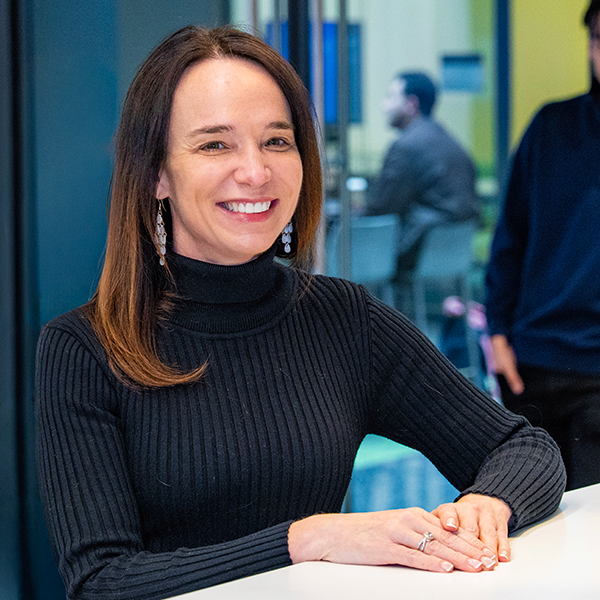



Talking to Vice Dean Cait Lamberton in her office in Steinberg Hall-Dietrich Hall, it’s tempting to think of her as a permanent fixture of Wharton life. With a deft feel for the pulse of the undergraduate student body, it’s easy to imagine that she’s been here since the days of Joseph Wharton himself.
It’s harder to imagine that the vice dean’s first job was as a quality control clerk for a truck mirror factory, or that she spent her undergraduate years studying not business, but English.
The journey might appear mystifying but, after conversing with her, the metamorphosis seems almost inevitable. I found the vice dean incredibly energizing, with a deep sense of curiosity that has clearly dominated her work as an educator, researcher, and now administrator.
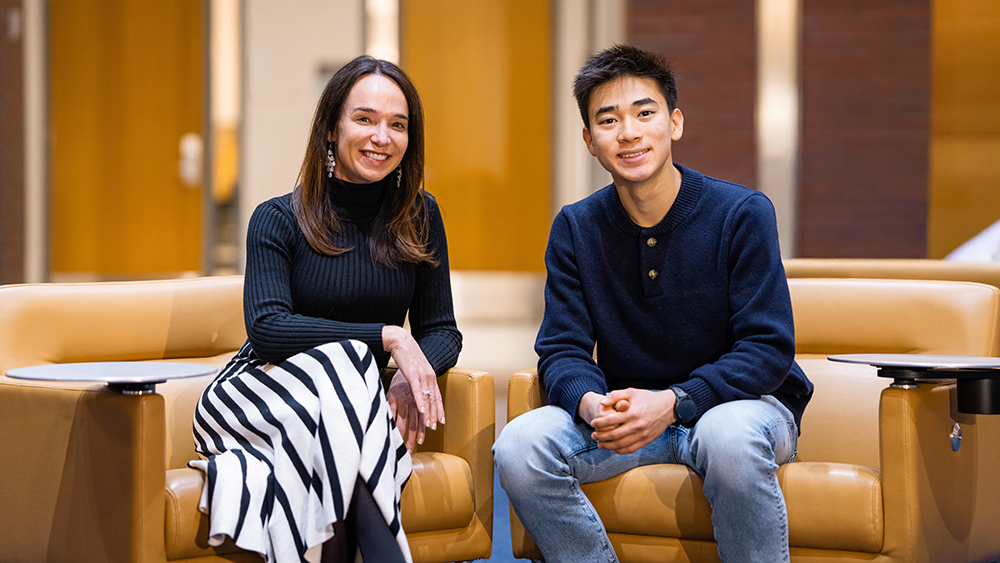
What made you want to take on this role?
A few years ago, I had a conversation with Deputy Dean Nancy Rothbard, and she asked, “Where do you want to go?” I realized I didn’t have a great answer, but I knew that I found the undergraduates energizing and exciting. At the same time, I knew that I didn’t want my entire job to be teaching, as wonderful as that is. I like dealing with new challenges and learning new things, and I knew I’d look for that moving forward.
Being vice dean was not on my bingo card. But when the opportunity came, I thought, that’s a new kind of challenge. There comes a time when you feel like you become very specialized in a narrow area. It’s great because you can access that part of your brain all the time. But I knew this would make me activate a whole different set of pieces in my brain.
What does your role look like day to day?
It’s different every day, which is what I love, right? I mean, I don’t like things to be the same every day. I’d lose my mind.
How would you describe Wharton’s students?
You can’t generalize about everybody, but many of them are quite fearless. They will share their ideas with you; they will try things they’ve never tried before. When I was younger, if I’d had a grand ambition, I’d have been afraid to state it. I don’t see that among Wharton undergraduates at all.
If you could change anything about the Wharton undergrad culture, what would you do?
There are times when — and this is true not only for Wharton students, but for Wharton as a whole — I think we could laugh more.
We could enjoy our success a little bit more — allow the success that we’ve had to make us feel more comfortable when things don’t go as expected.
When students have ideas or concerns, how do they reach you?

In the spring, because I won’t be teaching, I’ll have a lot more time for office hours, and I’ll set up a bunch of lunches that students can sign up for.
My email address is also not hard to find, but the email inflow is so large, it might take me a minute to get back to people.
What I’m learning is that I often don’t personally have the answer, but I can find other people who do. And that’s a fun process. A few days ago, I had a student in class who asked, “I’m really trying to figure out whether I’d want to start my career in discipline X or whether that’s going to pigeonhole me.” It was a little puzzle for me: who can you talk to who can give him some advice?
Why would you recommend an undergraduate business education?
An undergraduate business school teaches students generalizable models, frameworks, and techniques that allow them to look at the problems that society faces and connect them to the solutions being created.
This is a very specific experience: taking what you learn in the classroom and applying it. We’ve said for a long time that 50 percent of the learning in a Wharton education is in the classroom — and it’s true.
It’s like learning a language. It’s easy to learn in a classroom, but you show you’re fluent when you can navigate a complex situation. That’s what an undergraduate business school education is about.
Why do you consider Wharton to be one of the best business schools in the world?
Wharton has remained very true to its roots. It was the first undergraduate business school in the world — being first means you get to set the standard. And our faculty are encouraged to do consulting, own businesses, and be part of the world. The fact that Wharton encourages faculty to participate in the market and then bring that back into the classroom is part of what makes our classes quite remarkable.
We are also one of only two Ivy League universities with an undergraduate business program. Being part of this incredible university gives us access to a broader set of conversations. We have dual-degree programs that enrich our population a great deal, and we have access to a host of centers and resources like Venture Lab, which might not exist at a school without the broader umbrella that Penn offers.
I’ve also come to realize the power of our alumni network. They want to engage with students, and there are plenty of different resources they can offer, but they are particularly generous with their time. I’ve never seen anything like it.
I will literally meet people on the street who tell me they went to Wharton, and they’ll stop and say, “What can I do? How can I help? Can I talk to your students?” That’s pretty amazing. You can say, “That’s just Wharton being Wharton,” but it’s different from any other place that I’ve been. I couldn’t be more honored to be here.
— Alan Li, W’28
Posted: January 5, 2026